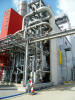
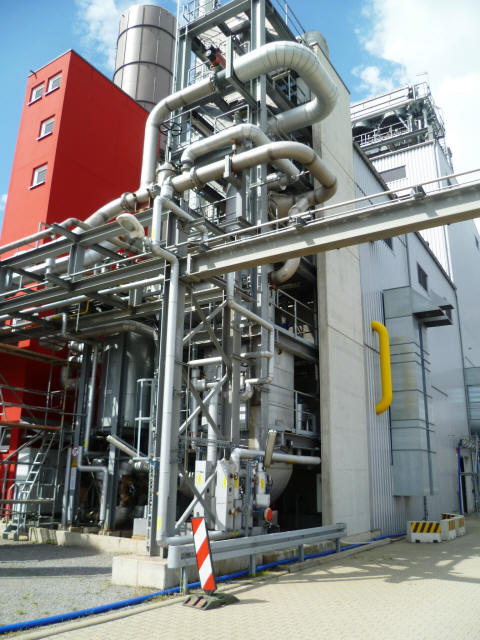
The power plant uses the Fischer Tropsch process to produce 300 bbl/day (45,000 litres/day) of synthetic fuel (synfuel) which further generates 45 MW power. In general, synthetic biofuel can both be blended with conventional diesel or sold as pure synthetic biofuel. Synthetic biofuel from this plant can only be used in diesel engines. The light components generated in its production (naphtha) can be used in refineries as part of gasoline fuel. In the process, more than 50 % of the biomass energy content is bound in high-quality fuel. About 4 kg of biomass are needed to produce 1 liter of synthetic biofuel.
The process is a three-stage gasification process resulting in the production of syngas:
• low temperature gasification
• high temperature gasification
• endothermic entrained bed gasification
The Fischer-Tropsch (FT) process is then used to convert the synthesis gas into an automotive fuel. The waxes formed during the FT synthesis are further processed using hydrocracking.
BtL fuels may be produced from almost any type of low-moisture biomass, residues or organic wastes such as short rotation trees, perennial grasses, straw, forest thinnings, bark from paper-pulp production, bagasse, waste paper or reclaimed wood or fibre based-composites.
The advantage of the BtL route to liquid transport fuels lies in the ability to use almost any type of biomass, with little pre-treatment other than moisture control. This is because the feedstock is gasified in the first stage of the process. The gas produced is then treated further to clean it, remove tars, particulates and gaseous contaminants, and to adjust the ratio of the required gases (hydrogen and carbon monoxide) to that required. The result is a balanced syngas that can be used in the second, catalytic, stage. Syngas may also be obtained by pyrolysis to form charcoal. The hot charcoal is then reacted with steam to produce watergas.
|
|
|
|
45 MW Biodiesel Plant [Project #1] [PLEASE CONTACT US FOR FURTHER INFORMATION]
| |
|
26949
Chagrin Blvd., Ste 304, Beachwood, OH 44122
Phone: +1 (888) 244-5820, Fax: +1 (888) 244-5820
For
further information please contact
info@timusglobal.com
|